
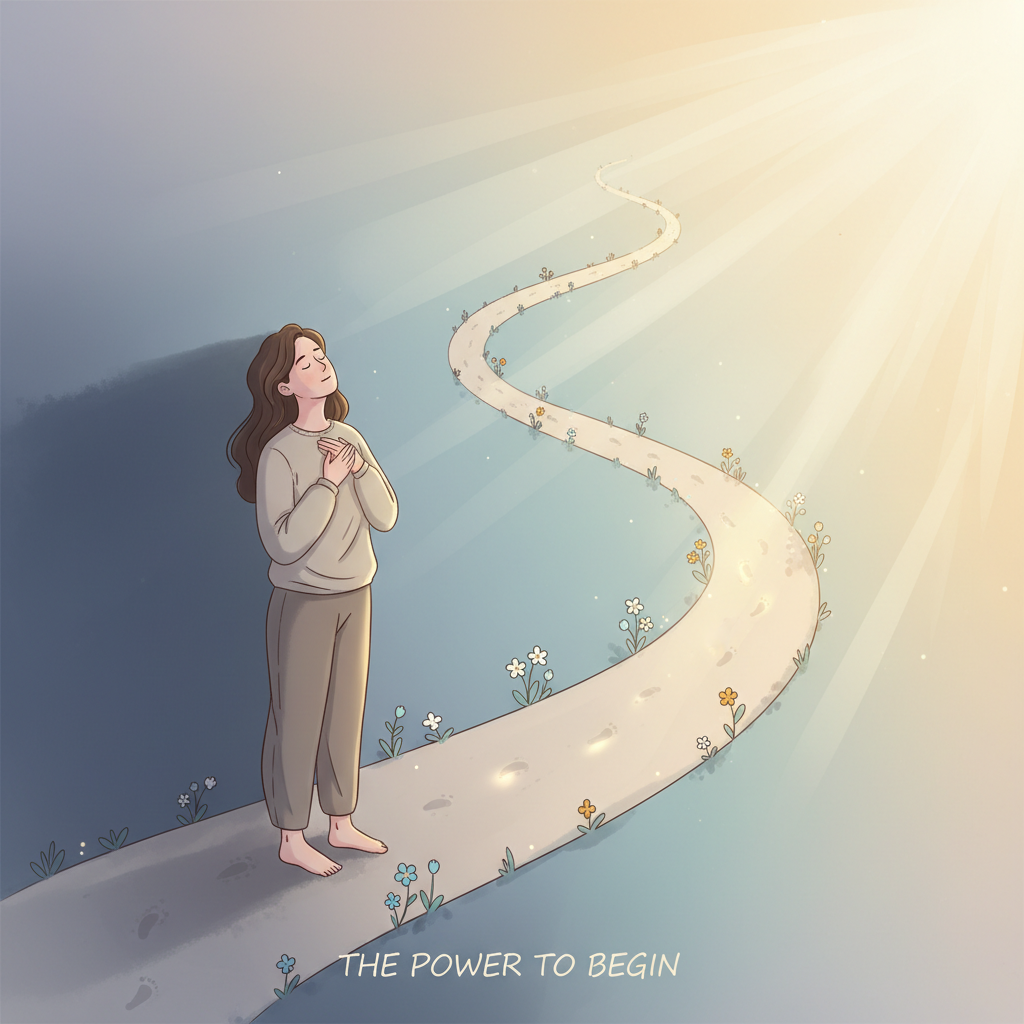
From helplessness to personal responsibility: How to escape the victim mentality
What if it is not life that controls us, but our thoughts that colour our lives? Many of us have experienced phases in which ‘everything seems to be against us’. The experiences of our listener Katja Fleischmann show that breaking out of the victim mentality starts with small steps – by pausing, taking responsibility instead of blaming others, and having honest conversations. This article brings together insights, practical exercises and tips on how listening can have a healing effect.
How to recognise a victim mentality
‘Victim mentality’ is not a characteristic, but an inner position (attitude). We experience ourselves as permanently helpless, with the causes supposedly always lying outside ourselves (‘I can't help it,’ ‘It's just the way it is’). Psychologically related to this is the concept of learned helplessness: those who repeatedly experience situations that cannot be influenced can generalise – and at some point believe that they have no effective influence whatsoever. This pattern has been described as a mechanism that can contribute to depression.
This impression is reinforced by cognitive (mental) distortions (thinking patterns such as all-or-nothing thinking, catastrophising, personalising). Distortions are normal but misleading mental shortcuts that intensify feelings and control actions. Recognising them is the first step towards change.
It is important to distinguish between real burdens and structural barriers that cannot be simply dismissed. Moving away from victimhood does not mean trivialising suffering or assigning blame – it means rediscovering your own sphere of influence alongside external conditions. Possible signs: persistent powerlessness, looking for causes only in external factors, brooding instead of acting, avoiding micro-steps. Mini self-check: ‘Which interpretation have I chosen right now? What second, equally plausible view could there be? What 5–10% step is within my power today?’
Why thoughts colour our reality – without trivialising them
There is almost always an evaluation between an event and a feeling. This is precisely where cognitive (mental) behavioural therapy comes in: thoughts influence how we classify situations, what feelings arise and what actions follow – and thus our experienced reality. At the same time, it is clear that the body, relationships, life circumstances and biological factors all play a role; thoughts are one lever among many. Evidence-based (scientific) treatment guidelines recommend cognitive (mental) and behavioural therapeutic approaches for depression – embedded in joint decision-making and tailored to severity and preferences.
Thought work therefore does not mean “thinking positively”, but rather examining things in a plausible and helpful way:
What cognitive (mental) distortions colour my view (e.g. overgeneralisation, “should” statements)?
What alternative interpretations are also compatible with the facts – and open up other next steps?
The turning point: pause and observe
A turning point in life is often not a big bang, not a dramatic moment. It often begins very quietly. For example, by pausing for a few seconds and listening to yourself. Perhaps you realise: ‘I don't really want to continue like this. Something is no longer right for me.’ This very moment can be the beginning of change.
Pausing means taking a short break. You stop reacting automatically and look inward for a moment. You take a slightly deeper breath and feel what is going on right now. What thoughts come into your head? What do you feel in your body – tension, pressure, tightness in your chest, a lump in your throat? And what is happening around you? Simply observing this can already change something, because you are stepping out of ‘autopilot mode’ for a moment.
You may notice: ‘I'm talking to myself very harshly right now’ or ‘I'm painting everything black’. This is not a mistake, but important information. You are beginning to recognise the story you tell yourself about yourself and your life. From here, you can gently ask yourself: ‘Is this story helping me right now? Or is there another perspective that gives me a little more breathing space?’ You don't have to ‘think positively’ right away. It's enough to find a slightly kinder, slightly more realistic perspective.
It helps to incorporate little reminders into your everyday life. A note on the mirror, a word on your mobile phone background or a bracelet can remind you to pause for a moment every now and then. The goal is not to be perfectly calm and composed. The goal is much smaller: you want to give yourself the chance to take a moment's distance and then decide more consciously how to proceed. It is precisely in these brief moments that a new path can begin.
Three guiding principles on the way out
If you have felt helpless for a long time, the path out of it can seem very long and complicated at first. You may ask yourself, ‘Where do I even start? What should I do next?’ It can help not to get lost in a thousand possibilities, but to rely on a few clear principles. You can think of them as three stable pillars that you can lean on when everything inside you is shaking.
The first pillar is your awareness. This means that you gradually become aware of what is happening inside you. Which thoughts keep coming back? Which feelings arise? How does your body react when you are stressed or sad? Many of us run on ‘automatic mode’ for years and hardly notice what is going on inside us. When you begin to simply notice your inner processes without immediately pushing them away or judging them, that is already a huge step. You don't have to do anything “right”; you can just look at it with curiosity: ‘Aha, so that's how I feel right now.’
The second pillar is responsibility instead of guilt. Perhaps you are used to blaming yourself – or shifting the blame entirely onto others. Both usually feel heavy and hopeless. Responsibility is something else. It means: "I cannot change the past, and much of what happens outside of me is beyond my control. But I do have influence over how I treat myself today and what small step I take next." Responsibility is quieter than guilt, but very powerful. It gives you back a bit of control without punishing you for feeling bad right now.
The third pillar is support. Being stuck in your own head is incredibly exhausting. Once you can express your thoughts out loud – to someone who listens to you without judging you – they often sort themselves out a little. You don't have to perform in a conversation, you can just be there, as you are. Support means that you don't have to walk this path alone. Someone is there who takes your journey seriously and listens to you attentively. This could be a friend, a counsellor, a therapist or someone from REDEZEIT FÜR DICH.
Mini practice: 5 exercises for everyday life
Theory is one thing, everyday life is another. You can read all you want about victim mentality, responsibility and mind reading – what matters is what you do in the little moments of your day. Especially when you're feeling down, big changes often seem overwhelming: ‘I'll never manage that,’ ‘It's too much.’ That's why mini steps are so important. They are deliberately small so that you can manage them even on difficult days.
‘Mini practice’ refers to short exercises that you can do without much preparation. You don't need any special equipment, a perfect environment or prior knowledge. The idea is to switch off autopilot for a minute or two and get in touch with yourself in a friendly way. Each of these little exercises is like a gentle reminder: ‘I'm still here. I have at least a little bit of influence over how I treat myself.’
The following five exercises are suggestions. You don't have to do them all. Perhaps you could start by trying one that appeals to you. The important thing is not that you do everything ‘right’, but that you start doing something. If you try an exercise for a few days in a row, you may notice that it gives you a little more breathing space. Even if your life doesn't change immediately on the outside, slowly more space will be created on the inside.
You can think of these mini practices as a toolbox. Some tools will suit you better than others. It's perfectly fine to take your time figuring out which exercises work for you and your daily routine and which ones don't. Just knowing that you have a few options to try out is often reassuring in itself.
60-second pause. Stop – take a deep breath – observe – ask: ‘What is the next helpful step now?’
Thought diary ‘Thought → Feeling → Action’. Note down the situation, your first thoughts, feelings and actions; then formulate a helpful alternative thought and observe the effect.
ABC note (Trigger – Evaluation – Consequence). Write down A (Trigger), B (Evaluation), C (Action) and experiment with an alternative evaluation.
The 100% question. ‘What 10% micro-step can I take today?’ Start small, repeat consistently and build up to 100%.
Seek an honest conversation. Tell someone you trust how you really feel – without expecting advice. Listening can relieve stress and provide guidance.
When things get tough: relapses are part of the process
Change almost never happens in a straight line. It is normal to have good days and bad days. You may feel better for a while, and then slip back into old patterns. You may brood more, withdraw or feel powerless again. Many people then think, ‘See, it's all pointless. I'm back where I started.’ But that's not true. Setbacks are part of every process of change. They don't mean you've failed. They just mean you're human.
It can help to prepare yourself a little for the possibility that such phases may occur. For example, you can think about what early signs you notice when things start to get difficult. Perhaps you sleep less well, perhaps you cancel meetings more often, perhaps you notice that your thoughts become particularly harsh or dark. If you are aware of these signals, you can react sooner.
You can also think in advance about what helps you a little bit in such situations. It doesn't have to be anything big. It might be that a short walk does you good, a quick chat with someone you trust, or five minutes of conscious breathing by an open window. A simple idea is: ‘When I notice that I am starting to withdraw, I first get myself a glass of water, take a few conscious breaths and then contact someone I trust.’ A small plan like this can help you avoid slipping back into old patterns.
Some people experience several depressive phases in their lives. In such cases, it can be helpful to work with professionals to develop an ‘emergency plan.’ This plan can include, for example, the first steps you can take and who you can call in an emergency. Refresher sessions or courses in which you practise mindfulness or other strategies can also help you to take better care of yourself in difficult times. The important thing is to remember that setbacks are okay. You are allowed to feel sad, tired or frustrated. And yet you can still say to yourself: ‘Today, I'll just start again with one small step.’
When you should seek help
Many people wait a long time before seeking help – out of shame, uncertainty or because they think that others ‘have it much harder’. But seeking support is a sign of strength, especially if you have been feeling unwell for a long time.
Please seek help if you feel down almost every day for several weeks, can hardly feel any joy and notice that you are just going through the motions. You may have thoughts such as ‘I'm worthless’, ‘Everyone would be better off without me’ or ‘I can't do anything anymore’. Perhaps you are sleeping poorly, have little appetite or are eating a lot, find it difficult to concentrate and feel that everything is becoming too much for you. At this point, at the latest, it is a good time to talk to someone who knows about these issues.
In Germany, you can first contact your family doctor. There you can calmly explain how you are feeling. Together, you can consider what might help you: for example, a conversation with a psychotherapist, a counselling centre or other services. If you do not yet know where to turn, your family doctor's office can often refer you to initial points of contact.
There are also services where you can talk to someone anonymously and free of charge. For example, you can reach the telephone counselling service around the clock at several nationwide numbers and also online via chat. For children, teenagers and young adults, there is also REDEZEIT FÜR DICH (TIME TO TALK FOR YOU), where people listen and sometimes help you organise your thoughts. Such conversations are no substitute for longer-term treatment, but they can be an important first step if you are feeling alone.
Very important: If you feel that you might harm yourself or if you are having very dark thoughts, then this is an emergency. In such a situation, it is important to seek help immediately. You can call the emergency number 112, go to an emergency room or ask someone close to you to accompany you. It is okay to need other people in such a situation. No one should have to deal with this alone.
An open ear makes a difference: How REDEZEIT FÜR DICH supports
At REDEZEIT FÜR DICH, you will find people who listen without judging. The attitude behind this is genuine interest, empathy and the conviction that listening can be the first step towards regaining the ability to act.
REDEZEIT FÜR DICH is committed to ensuring that people in mental health crises can find help more quickly and easily and that no one has to face their worries alone. Listening, supporting and strengthening – this is the shared approach that both organisations continue to work from.
To take away for you
Perhaps your path is difficult right now. Perhaps you often feel helpless and have the feeling that everything is rolling over you. It can help to take a few simple sentences with you. You can say to yourself: ‘I am allowed to pause.’ A short breath, a moment in which you consciously notice what is going on inside you, can already be a step away from autopilot. You don't have to change everything right away. It is enough to allow yourself to take a small next step.
You can also tell yourself: ‘Setbacks are part of the process.’ If things get difficult again, it doesn't mean that everything was in vain. It just means that you need more support right now. Every day offers you the opportunity to start afresh – sometimes in very small ways, but still important. And you can tell yourself: ‘I don't have to go through this alone.’ There are people and places you can turn to: doctors, therapists, counselling centres, telephone and online services, and also volunteers who are simply there to listen. A conversation can be the first step towards making things a little easier.
If you are reading this, you have already taken a step: you are taking care of yourself and your mental health. That is courageous. And it is a sign that there is something inside you that wants to live and grow – even if it may feel completely different right now.

About the author
I am listener Katja Fleischmann. After a health breakdown caused by exhaustion, illness and personal tragedies, my journey began: I wanted to understand how thoughts shape our reality and how we can regain strength and well-being through mental change.
Today, I am a coach, trainer and speaker, and with my programme ‘Wachstums-MOMENT’ (Growth MOMENT), I accompany women who achieve everything but feel empty and exhausted inside. Together, they learn to understand their stress, heal old wounds and rediscover their inner strength – for more ease in everyday life.
Mother of a son, married and firmly convinced: what worked for me can also work for others.